RE: Expanded Canada–India Security Cooperation increases India’s capacity for transnational repression
.png)

22 Assu, Nanakshahi 558 | October 8, 2026 CE
Minister Gary Anandasangaree
Minister of Public Safety
House of Commons
Ottawa, Ontario
K1A 0A6
gary.anandasangaree@parl.gc.ca
Re: Expanded Canada–India Security Cooperation increases India’s capacity for transnational repression
Dear Minister Anandasangaree,
I write today to express grave concern regarding the Government of Canada's October 7, 2026, announcement of expanded security and law enforcement cooperation with India following meetings between David Morrison, Senior Diplomatic and International Affairs Advisor to the Prime Minister, and India's National Security Adviser, Ajit Doval.
According to the official readout issued by the Privy Council Office, Canada and India agreed: "to deepen cooperation in combating transnational organised crime, terrorism and violent extremism, human and drug trafficking, cybercrime, extortion, and extradition of criminal offenders." The readout further confirms commitments to strengthen institutional mechanisms and establish new channels for information-sharing.
These developments raise serious questions about Canada's commitment to addressing Indian transnational repression (TNR), particularly given the documented history of Indian foreign interference targeting the Sikh community in Canada, documented instances of Indian state involvement in violence against Sikh activists, and the absence of any meaningful accountability for the officials responsible.
It is particularly alarming that these commitments were advanced through direct engagement with Ajit Doval, who occupies a central position in India's national security and intelligence establishment. Indian intelligence and security officials under Doval's supervision have been implicated in allegations of surveillance, intimidation and violent operations against Sikh activists abroad, including the assassination of Shaheed Bhai Hardeep Singh Nijjar in June 2023. Yet there has been no meaningful public accounting of responsibility at the senior levels of the Indian government.
Equally troubling is the complete absence of any reference to transnational repression, foreign interference, or accountability for Indian state-linked activities in Canada in the government's public readout. Instead, the announcement celebrates growing mutual trust, expanded economic negotiations, a prospective bilateral defence relationship, and deeper security cooperation.
For Sikhs in Canada, this raises a fundamental question about whether the Government of Canada is prepared to expand the very mechanisms that India has sought to exploit against Sikh activists without securing any accountability or establishing guarantees against further repression.
India's document efforts to criminalize Sikh political advocacy
These concerns are neither speculative nor disconnected from the findings of Canada's own national security institutions. The Public Inquiry into Foreign Interference, led by Justice Marie-Josée Hogue, examined India's efforts to influence Canadian policy toward Sikh political advocacy where Justice Hogue concluded that: "India has tried to pressure Canada to go beyond the parameters of Canadian law to counter supporters of an independent Khalistan." The Commission further identified India's efforts to manipulate Canadian policy to: "have Canada's position align with its own... particularly about supporters of Khalistani separatism."
These findings are of direct relevance to the newly announced security arrangements.
Canadian intelligence reporting has identified India's tendency to conflate lawful advocacy for Khalistan with threats to its national security. Canadian intelligence assessments indicate that India "perceives anyone engaged in Khalistani separatism as a seditious threat to India's domestic stability."
India's longstanding demands for Canada to take action against pro-Khalistan activists in Canada must be understood in this context. Political advocacy for Khalistan cannot be criminalized merely because the Government of India regards such advocacy as contrary to its territorial or political interests. The danger is that expanded intelligence-sharing, law enforcement cooperation, counter-terrorism coordination and extradition arrangements will provide additional institutional pathways through which politically motivated allegations originating from India can target dissidents in Canada. Achieving this ability has been a key piece of India's public and clandestine policy vis-a-vis Canada for decades.
This concern extends beyond criminal prosecutions and extraditions. It includes the misuse of immigration and inadmissibility proceedings, national security screening, passport restrictions, no-fly listings, financial measures and other administrative mechanisms that can impose serious consequences without the safeguards associated with ordinary criminal proceedings. Canada must ensure that its institutions do not become instruments through which a foreign government suppresses lawful political advocacy.
International human rights experts have explicitly warned against the misuse of these mechanisms
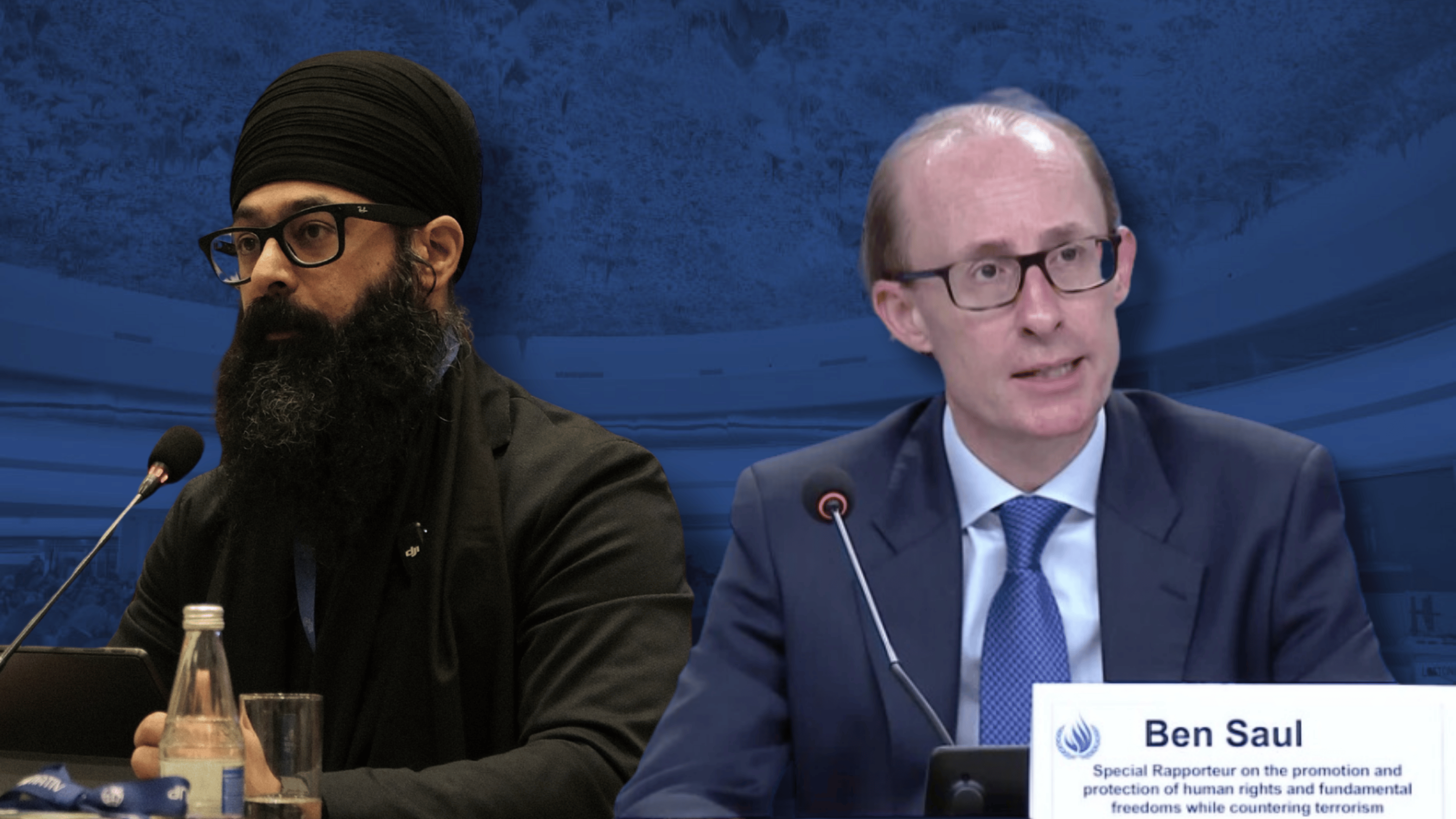
The risks arising from international legal and security cooperation are expressly recognized by United Nations human rights experts. In their Joint Statement on Transnational Repression, issued September 23, 2026, UN human rights experts identified the misuse of international law enforcement and legal cooperation mechanisms as a recognized method of transnational repression. Paragraph 10 expressly raises concern about the:
"misuse of international and regional law enforcement and legal cooperation mechanisms (including Interpol Red Notices and Diffusions, extradition and mutual assistance, counter-terrorism and national security frameworks and regional arrest warrant procedures)... and the abuse of measures to combat money laundering and the financing of terrorism, and other financial measures (such as the seizing and freezing of assets and restrictions of access to financial services)."
These are precisely the categories of cooperation that Canada is now seeking to expand with India.
More importantly, the experts expressly addressed the obligations of states whose cooperation may facilitate repression by foreign governments. In their recommendations, the experts called upon states to:
"Refrain from aiding or assisting in acts of transnational repression by other States, including through the misuse of information sharing, surveillance cooperation, joint operations, extradition and mutual legal assistance, or by allowing foreign officials to operate in the State's territory to commit acts of transnational repression;"
They further called upon states to:
"Prevent the misuse, for politically motivated and other improper purposes, of frameworks to counter counterterrorism (including to counter terrorist financing) and organised crime (including money laundering), other national security and emergency measures, sanctions regimes, immigration systems, extradition procedures and international legal cooperation mechanisms;"
These recommendations establish a clear international human rights framework against which Canada's proposed cooperation with India must be assessed.
The Office of the United Nations High Commissioner for Human Rights has similarly emphasized the need to:
"Ensure that extradition procedures are transparent, efficient, take into account international human rights and refugee law safeguards and guarantee compliance with the prohibition of refoulement and respect for fair trial;"
The UN Special Rapporteur's report Safe Digital Environment Enabling the Critical Work of Human Rights Defenders (A/HRC/63/52) further recommends that states review international cooperation requests, cross-border data-sharing, mutual legal assistance and extradition to prevent their misuse against human rights defenders, while establishing independent review and effective remedies.
Taken together, these international standards recognize that transnational repression is not confined to clandestine surveillance, disinformation or physical violence. It can also be carried out through ostensibly legitimate legal, administrative and security frameworks when those mechanisms are exploited to target political dissidents and human rights defenders abroad.
Canada's Extradition framework requires reform, not expanded exposure to political interference
The government's explicit commitment to deepen cooperation on the extradition of criminal offenders is particularly concerning. In June 2023, the House of Commons Standing Committee on Justice and Human Rights presented its report, Reforming Canada's Extradition System, following extensive parliamentary study and consultation with leading legal experts.
The report identified the need for substantial reforms to Canada's extradition framework, including stronger safeguards for individual rights and greater scrutiny of the exercise of executive discretion.
Sikh and other civil liberties organizations have raised concerns for several years that Canada's extradition process is currently a highly discretionary and politicized process which prioritizes administrative efficiency over maintaining meaningful Charter rights and Canada's international human rights obligations.
Sikhs across Canada have repeatedly called for implementation of the Committee's recommendations to ensure that extradition decisions are subject to meaningful judicial oversight and cannot be influenced by foreign interference, partisan considerations or short-term foreign policy interests.
These concerns acquire particular urgency where the requesting state has been documented as attempting to pressure Canada to act beyond the limits of Canadian law against supporters of an independent Khalistan and explicitly raised the issue of extraditions of political dissidents on numerous occasions.
Any expansion of extradition or mutual legal assistance cooperation with India, without first addressing these vulnerabilities, risks exposing Sikh activists and other individuals to politically motivated proceedings and serious violations of their fundamental rights.
Accountability cannot be exchanged for economic and diplomatic cooperation
The October 7 announcement must also be assessed against the broader direction of Canada–India relations. The government's readout expressly links growing security cooperation with progress toward a Comprehensive Economic Partnership Agreement and the prospect of a substantive bilateral defence relationship.
Canada maintains diplomatic and economic relationships with many states whose policies it may dispute. However, the pursuit of closer relations cannot justify overlooking well-founded allegations of state-sponsored violence, foreign interference and transnational repression within Canada.
The Government of Canada has publicly acknowledged serious Indian state-linked activity directed against individuals in Canada. Nevertheless, the public has not received a comprehensive accounting of the full scope of these activities, the role of Indian officials, the information available to Canadian institutions, or the measures being taken to prevent their recurrence.
The apparent normalization of security relations, without publicly articulated conditions concerning accountability and human rights, raises serious concerns that the interests and fundamental rights of Sikhs in Canada are being subordinated to broader economic and geopolitical objectives.
The government must explain how it reconciles its acknowledgement of Indian transnational repression with its decision to deepen cooperation in areas that UN experts have specifically identified as susceptible to misuse.
It must also explain what assurances, safeguards and accountability measures have been established before further sensitive information is shared with Indian security and intelligence agencies.
The lives, rights and political freedoms of Sikhs in Canada cannot become bargaining chips in the pursuit of closer economic relations with India.
Recommendations
In light of these developments, Sikhs across Canada call upon the Government of Canada to take the following steps:
- Immediately suspend and independently review security, intelligence and legal cooperation arrangements with India that may facilitate transnational repression, including intelligence-sharing, mutual legal assistance, extradition cooperation, joint training, surveillance cooperation and related information-sharing arrangements.
- Implement the recommendations of the Standing Committee on Justice and Human Rights' June 2023 report, Reforming Canada's Extradition System, to strengthen Charter protections, judicial oversight and safeguards against politically motivated extradition proceedings.
- Undertake a transparent review of cases in which Sikh activists have been subjected to criminal, immigration, national security or administrative measures potentially influenced by Indian intelligence, information-sharing, diplomatic pressure or discriminatory profiling. Where improper influence or arbitrary action is identified, effective remedies must be provided.
- Ensure meaningful accountability for Indian officials implicated in foreign interference, surveillance, intimidation and violence in Canada, including independent investigation, appropriate criminal proceedings, diplomatic measures and the exclusion or expulsion of officials involved in unlawful activity, where warranted by the evidence and applicable law.
- Establish an independent public inquiry into Indian transnational repression in Canada, including the role of Indian diplomatic and intelligence personnel, the use of Canadian institutions and legal cooperation mechanisms, the adequacy of protective measures for targeted individuals, and the decisions made by Canadian authorities in responding to known threats.
Canada cannot credibly condemn Indian transnational repression while simultaneously expanding sensitive security and legal cooperation without demonstrating how those arrangements will be protected from political misuse.
In order to address these concerns, I urge you to meet with representatives of the Sikh Federation to discuss these concerns and the steps necessary to ensure that Canada's international engagements do not undermine its domestic constitutional obligations or its commitments under international human rights law.
Sincerely,
Prabjot Singh
Legal Counsel
Sikh Federation Canada